Designing for the people who hold patient communities together
A B2B platform that gives patient advocacy group (PAG) leaders real tools to run rare-disease communities — replacing the spreadsheets, email, and Facebook groups they'd been managing everything on.
+10%onboarding completion
End-to-endowned the PAG Leader Platform
70+advocacy groups on the platform
- overview
- 1 year 8 months · ongoing · Senior Product Designer
- contribution
- Owned the PAG Leader Platform end to end: research, strategy, prototyping, and delivery. Contributed to the patient platform — redesigned onboarding and led the AI research for the patient mobile app and its AI advocate.
- team
- CEO2 product ownersdesign directorpag platform designer (me)patient platform designer2 developers
Background
When someone gets a rare disease diagnosis, the first place they turn is often a Facebook group. PAG leaders are the people running those groups — patients, caregivers, parents — managing whole communities through spreadsheets and email, on volunteer time. Citizen Health set out to give them a real platform.
I joined with almost no prior designs to build on. I own the PAG Leader Platform end to end — research, strategy, prototyping, and delivery — and have also contributed to the patient-facing platform (web and mobile).
loading the interface
The Challenge
We knew PAG leaders needed better tools. What we didn't know was what those tools should actually look like.
- No clear product direction — features were hypotheses, not certainties; the platform had to be defined as much as designed
- Two very different users — PAG leaders and patients, both needing a coherent cross-platform experience
- Stakeholder vs. user tension — leadership had strong opinions; research didn't always agree
- Early-stage reality — priorities shifted constantly, and design had to move fast with limited process
“Help us recruit and convert patients”
“Make Citizen easy for PAG leaders — we are busy and under-resourced”
“Show us the data — make it meaningful to families”
Process
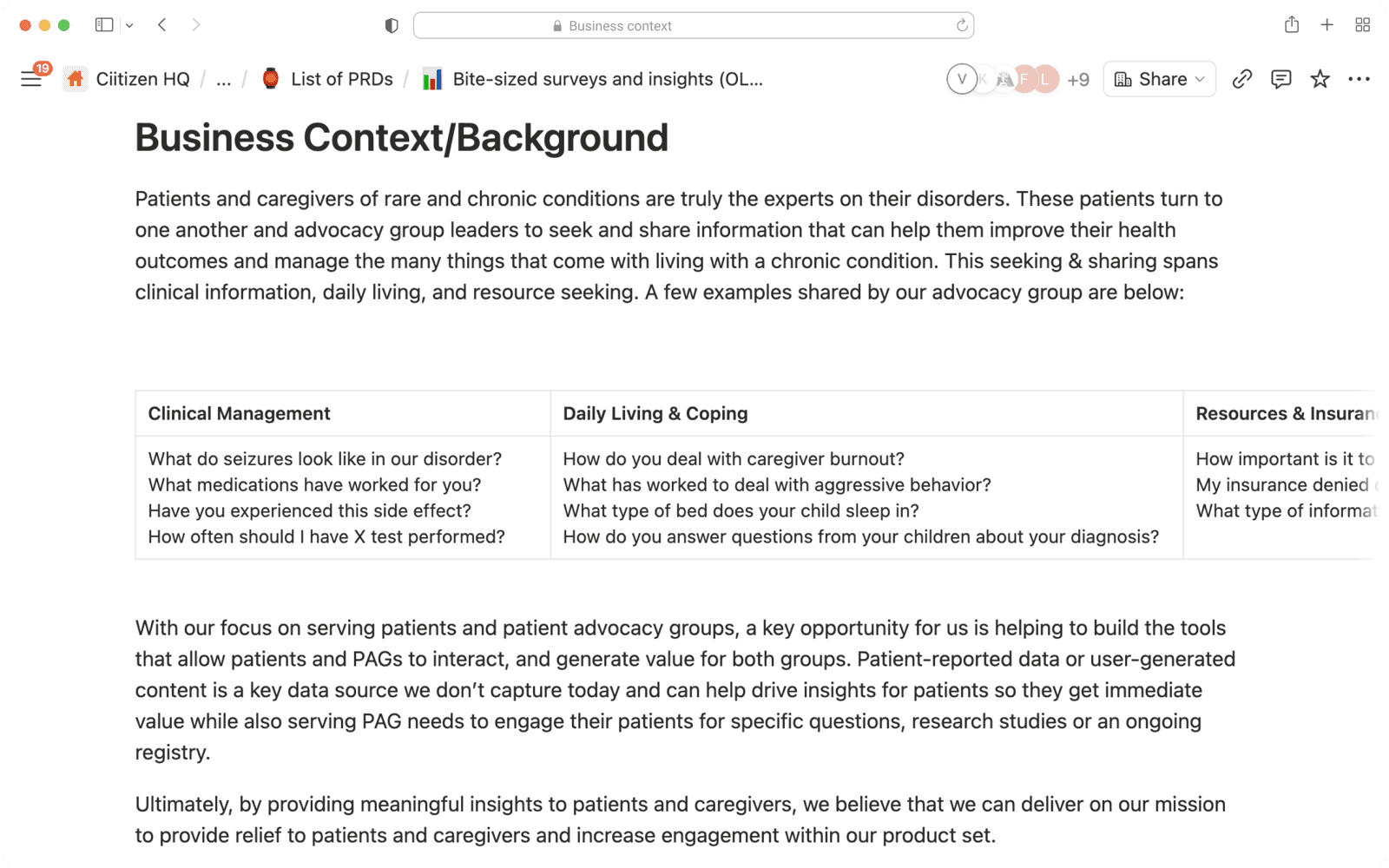
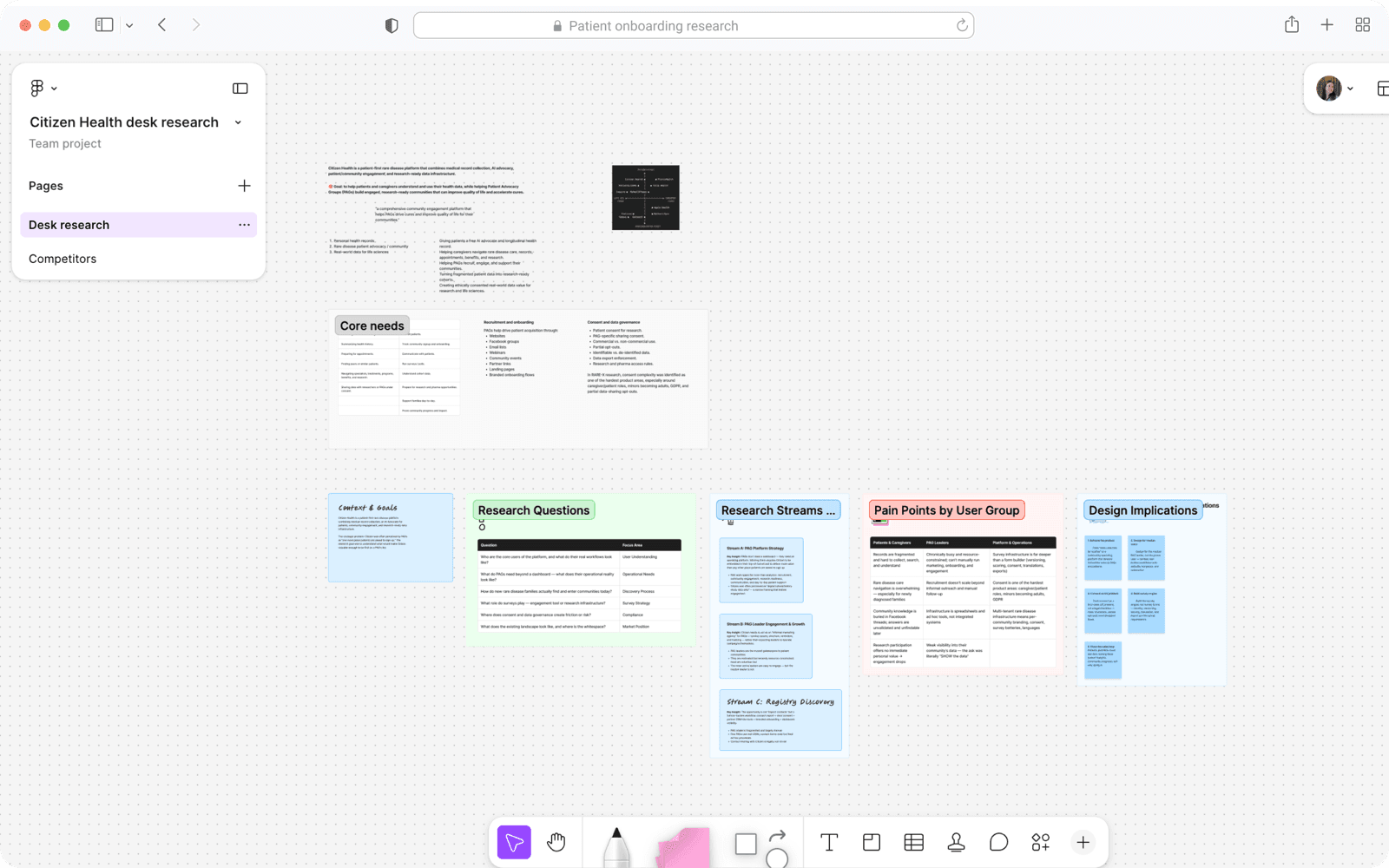
✶ Research first. When I joined, a lot of research already existed but it lived in scattered docs and past discovery sessions — nobody had synthesised it into product direction. I ran a structured desk research pass and competitive analysis, then worked closely with the CEO and PO — using direct input from PAG leaders already partnering with the company to shape features. In an early-stage startup, "research" often meant quick conversations and educated guesses. I pushed for rigour where I could; made peace with uncertainty where I couldn't.
✶ Kept both platforms in sync. The PAG and patient experiences are tightly connected — a survey a leader creates becomes something a patient answers. I worked closely with the patient-side PO to map the cross-platform logic and catch conflicts early, before they became dev problems.
loading the interface
loading the interface
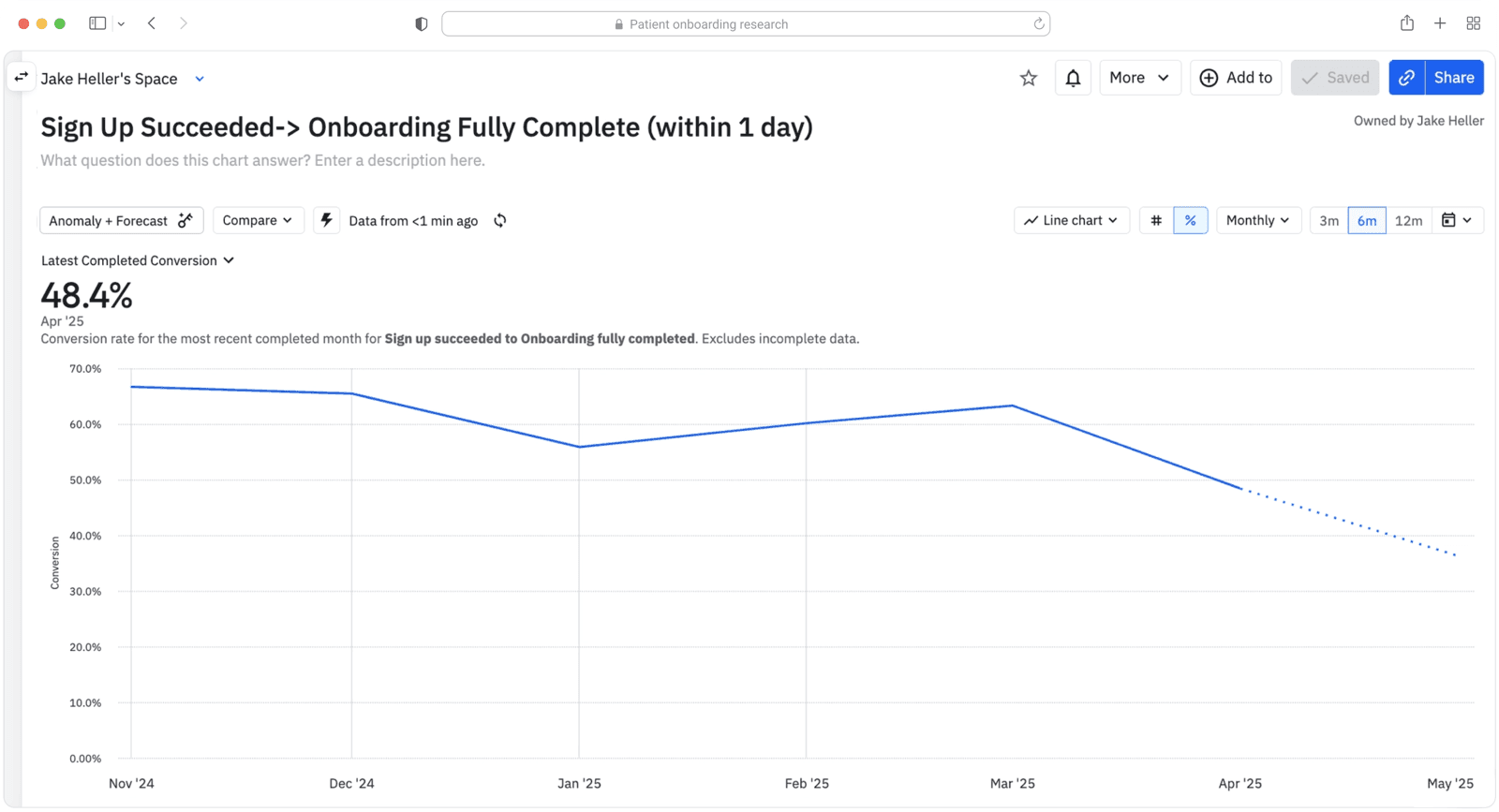
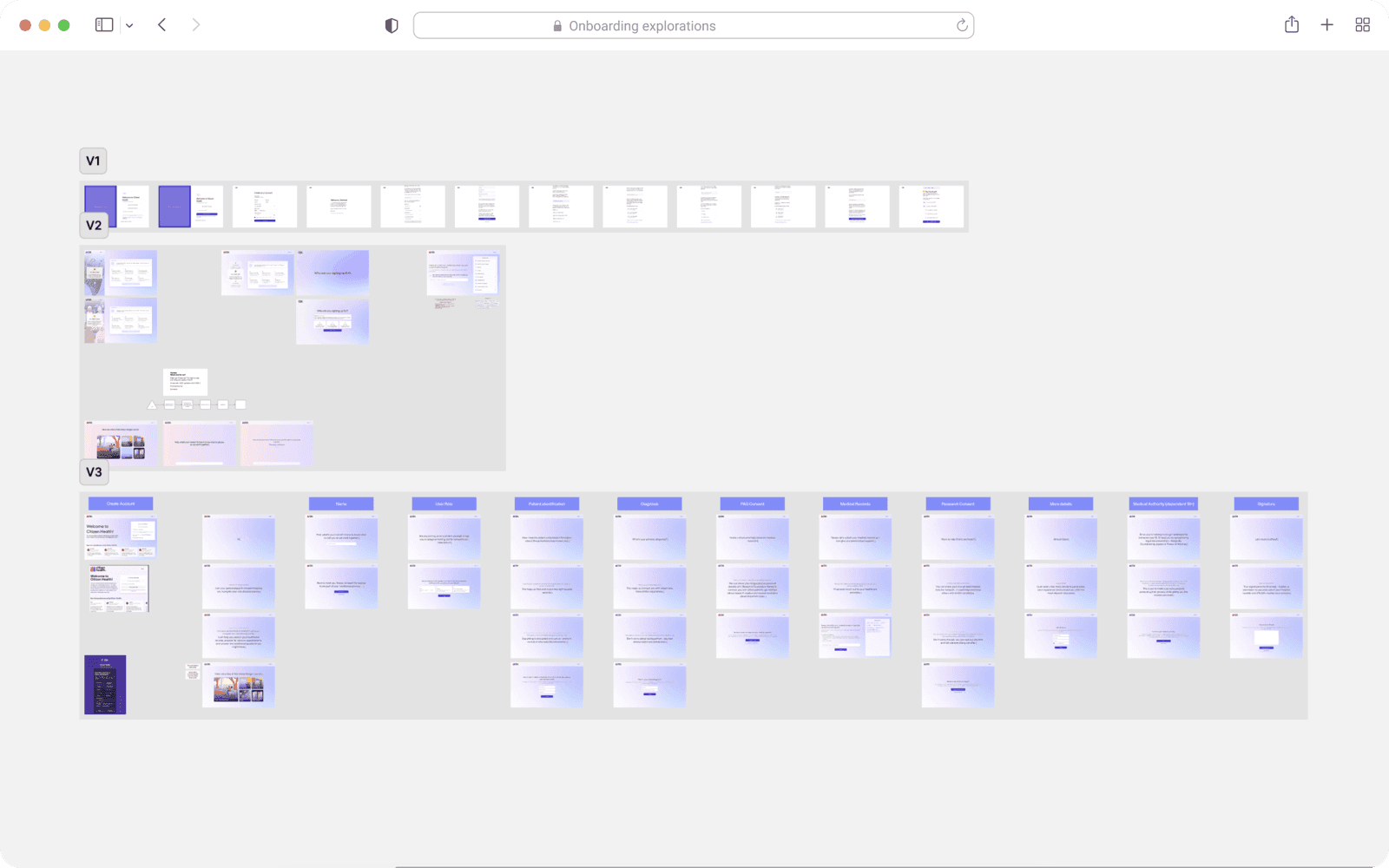
✶ Pushed back when it mattered. On patient onboarding, leadership wanted to collect as much information as possible upfront — a reasonable instinct, but one that clashed with what we were seeing in the data. Together with the Design Director, I ran usability testing on the existing onboarding with real patients. We watched them hesitate at complex medical terminology, worry about making mistakes, and frequently drop off before finishing. The case for a redesign wrote itself — but we still had to argue for it more than once. The result was a compromise: a simpler, warmer flow, with some of leadership's requirements still in, just handled more gently.
loading the interface
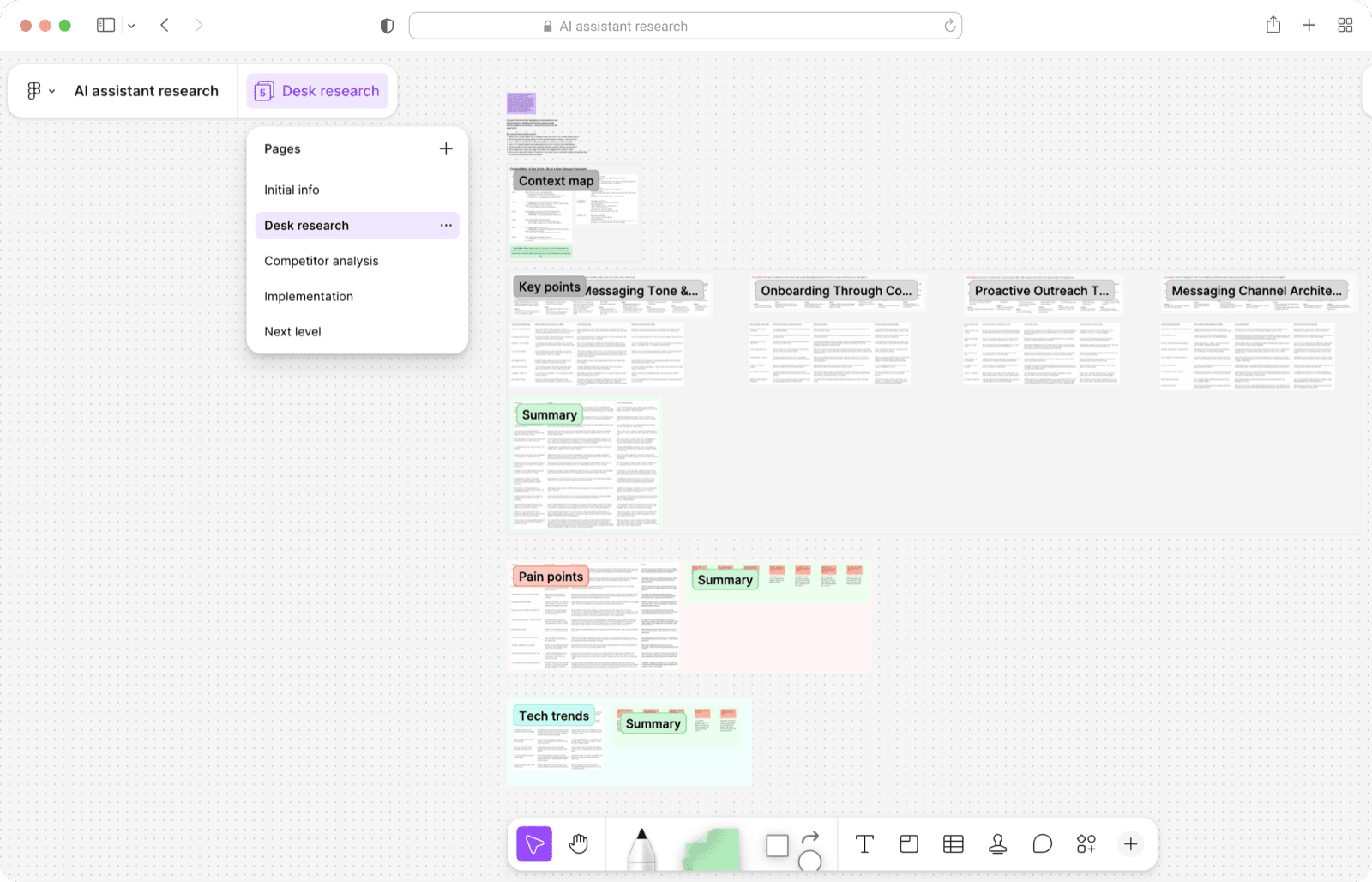
✶ Researched the AI experience before a single screen was designed. Ahead of the patient mobile app launch, I benchmarked how companies use AI and messaging for proactive health guidance — PicnicHealth, Guava, NHS digital messaging, WhatsApp Business — mapping patterns across trust signals, tone, notifications, onboarding, and caregiver workflows. The goal: understand what makes an AI health assistant feel genuinely useful rather than intrusive.
loading the interface
Key findings that shaped the direction:
- Sensitive health info should never appear in notifications — the right model is a pointer (why now + one next step) that brings users into the app, not a message that exposes PHI on a lock screen
- Records are only valuable when tied to action — the whitespace competitors leave open is the action layer: turning a new result or appointment into concrete next steps
- Silence kills trust — users need visibility into what the AI advocate is doing: drafted, waiting, received, follow-up due
- Caregiver-first architecture is an unmet need — rare disease care is often managed by caregivers, not patients; existing tools largely ignore this
The bottom line I delivered: don't build another portal or chatbot — build a trusted advocacy workflow system.
Solutions
✶ Patient onboarding — fewer steps, simpler language, warmer tone, progressive disclosure.
loading the interface
✶ PAG Leader Platform — designed end-to-end from near-scratch:
- Home — leader dashboard: everything new since the last visit (updates, news, fresh data)
- contact registry — leader dashboard: everything new since the last visit (updates, news, fresh data)
- Insights — dashboard with demographics, diagnoses, symptoms, medications, mutations
- Surveys & Answers — AI-assisted community surveys and Q&A tools
- Widgets — embeddable branded content to drive patient sign-ups
- AI Library — leaders train the AI advocate with their own research and resources
Results
✶ Patient onboarding redesigned — completion rose by around 10%, lowering drop-off and getting more patients through to the platform where they could actually benefit from it.

Citizen Health · patient onboarding
✶ PAG Leader Platform designed end-to-end from a near-blank canvas.
✶ Set the AI Advocate direction for the patient mobile app — research and benchmarking that framed it as a trusted advocacy workflow, not another chatbot.
✶ Quarterly milestones delivered on schedule across a fast-moving, constantly shifting product.
Citizen Health · contact registry
Reflection
In healthcare, an AI assistant doesn't earn trust by being clever — it earns it by being legible. The most important decision on this project wasn't a screen; it was refusing to build another chatbot. People handling a rare-disease diagnosis don't need something that talks. They need something that shows its work: what it did, what it's waiting on, what happens next.
The other thing I keep coming back to: the people we were designing for were volunteers. Every hour of friction we removed was an hour they got back for their community.