A self-initiated product concept
A self-knowledge app that treats you as many, not one, where you meet the different “parts” of yourself in an interactive 3D constellation. Your mirror.
- Overview
- 3 months · Personal project · designed & built solo
- Built in 3D
- A live constellation in React Three Fiber
- Contribution
- Took the whole thing end to end on my own: from first principles to a working MVP I built myself (Claude Code). Full Double Diamond discovery, a from-scratch UI kit and visual language, an interactive 3D constellation (Next.js, React Three Fiber), and UI animation to make it feel alive. Research, design, and build.
- Stack
- FigmaClaude CodeClaude DesignNext.jsReact Three FiberVercel
Background
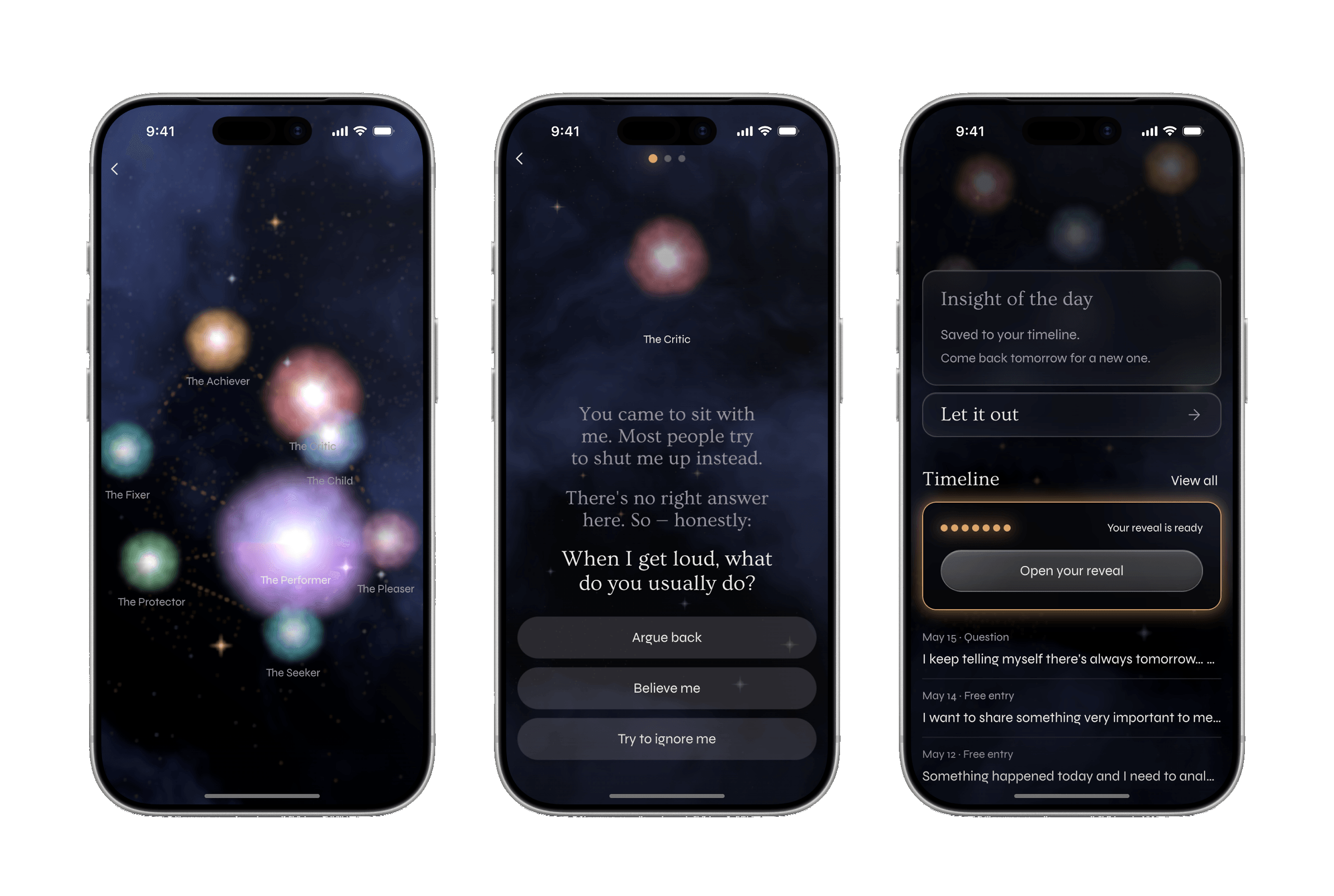
Unmet is a mobile self-knowledge app built on a plural model of the self.
It helps you meet the different “parts” of yourself: the inner voices, patterns and roles that show up in different moments. They live in an interactive constellation you can explore. Your mirror.
I took the whole thing end to end, on my own: from first principles to a working MVP I coded myself.
Problem
Most reflective apps treat the self as a single unit to be optimised.
People experience an inner conflict (one part pushing, one part protecting, one part just wanting rest), and that conflict rarely gets named, let alone explored.
- No established pattern to borrow: self-knowledge isn’t habit tracking, and the usual UI conventions didn’t fit
- An abstract idea that had to feel concrete: “parts of yourself” needed a form people could touch
- Introspection that shouldn’t feel clinical: journalling apps often read like homework
- Everything from zero: no design system, no visual language, no codebase
Process
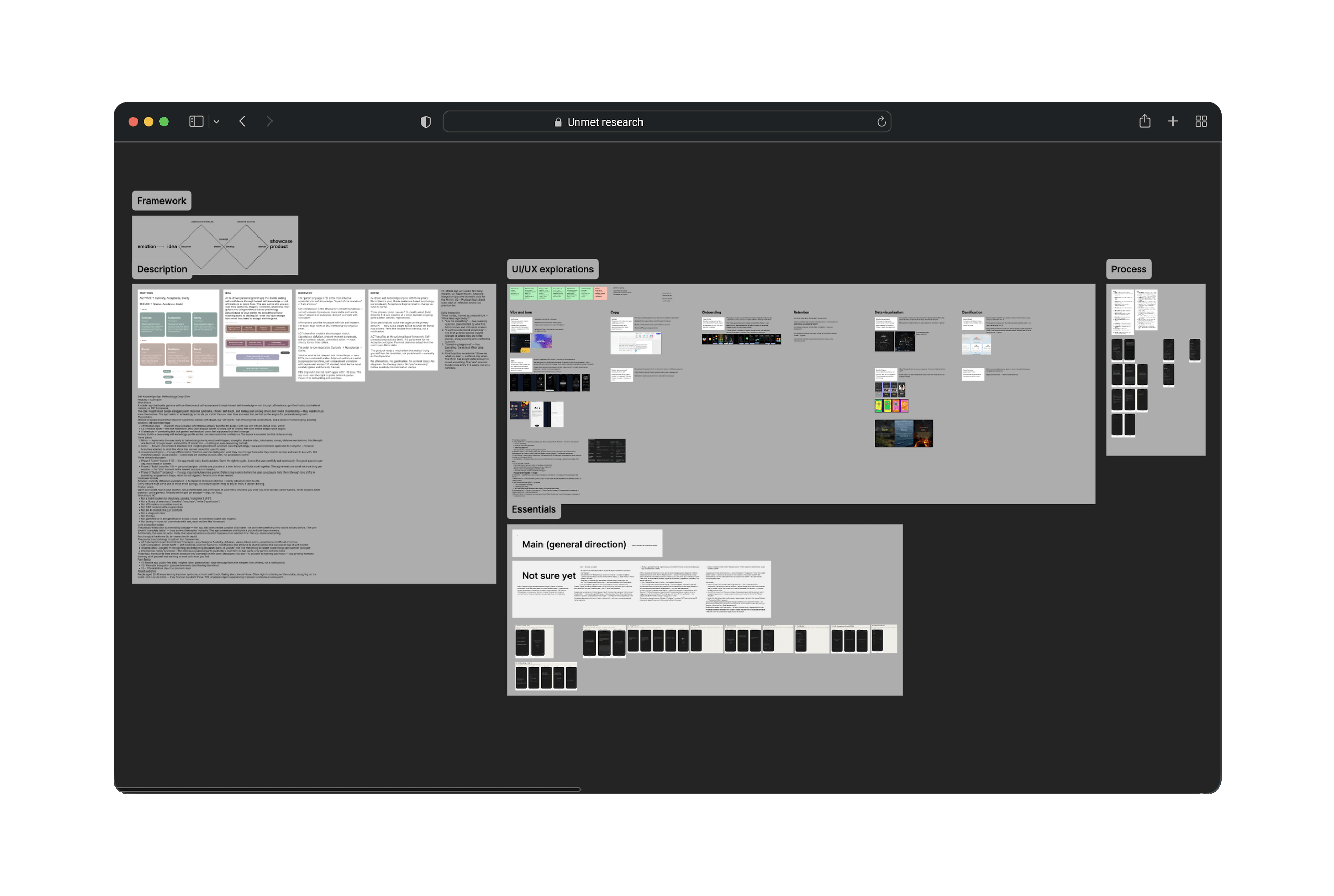
Full Double Diamond discovery. I framed the user, the emotional need, and the core value: introspection that feels like exploration. Who is this for, what are they carrying, and what would actually help?
Found the form before the features. The plural model of the self needed a metaphor that could hold it: parts as points of light you can move around, approach, and get to know.
A living constellation gave the abstraction a body.
Designed the whole experience. Onboarding into the idea, the constellation itself, daily insights, free journalling, conversations with a single part, and periodic Wrapped-style “reveals” that surface patterns noticed over time.
Built it. I wrote the code myself with Claude Code: a clickable mobile prototype, with the constellation rendered in 3D (Next.js, React Three Fiber). Working in Figma, Claude and Vercel across research, prototyping, and build.
Solutions
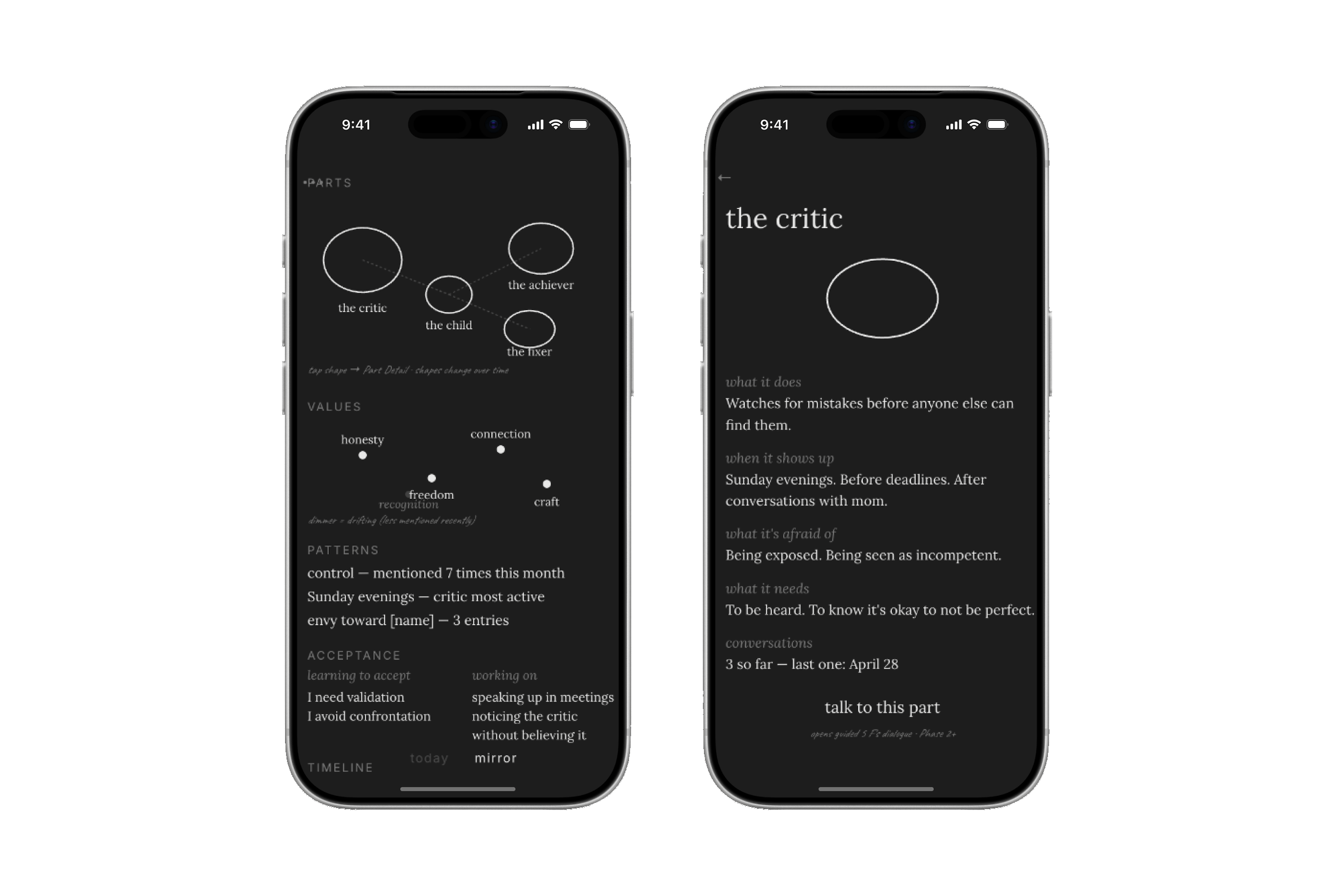
A constellation, not a dashboard. Parts of the self live as an interactive 3D constellation, something to wander through rather than a list of metrics to score.
Meeting a part. Conversations happen with one part at a time, in a three-step “befriending” flow. The language throughout is curious.
Insights arrive on their own. A daily question, a place to write freely, and periodic reveals that show a pattern back to you once there’s enough to see.
Results
Three months of solo work produced a working MVP and a complete product concept.
- A working MVP I built myself: clickable mobile prototype with an interactive 3D constellation (Next.js, React Three Fiber), built from zero
- Complete product concept: full Double Diamond discovery, UX, and screens
- End-to-end and solo: research, design, and build
Reflection
Unmet is where I proved to myself that I don’t have to stop at the handoff.
Taking an idea from a blank page to something you can actually open and use changes how you design: you start making decisions you’ll have to live with.
It also sits on the same question as the rest of my work. A product that asks people to look inward has to earn that access first. Not by being gentle in tone, but by being honest about what it’s doing with what it sees.